
SNOW & WINTER MAINTENANCE ATTACHMENT GUIDE
Snow Plows
A practical guide to snow plow attachments for wheel loaders, skid steers, compact track loaders, tractors and backhoe loaders: blade types, effective width, trip protection, cutting edges, hydraulics, route planning, wear and buying checks.
A snow plow is one of the simplest-looking attachments on a machine, but good plowing depends on much more than blade width. The blade has to match the carrier, route, snow type, surface and storage plan. A plow that is excellent on a wide municipal road can be frustrating in a compact yard, while a narrow easy-handling blade may take too many passes on a large open site.
01 / WORKING PRINCIPLE
What a snow plow attachment actually does
A snow plow converts the carrier’s traction into a controlled sideways or forward movement of snow. The moldboard catches the snow, lifts and rolls part of it, then redirects it according to blade shape and angle. A straight blade angled to the right produces a continuous windrow on the right side of the route. A V-plow can split a drift, run straight, or form a scoop depending on the design. Winged and multi-section plows can change working width and containment while moving.
The carrier provides the pushing force, but the blade geometry determines how much of that force becomes forward resistance, side force and scraping pressure. This is why the same carrier can feel stable with one blade and be pushed sideways by another. Wet snow, an aggressive blade angle and a wide moldboard can create high resistance even when the nominal snow depth looks modest.
Plowing is also a material-placement job. A plow does not make snow disappear. Every pass leaves the material somewhere else, and that storage area shrinks as the season continues. The most productive setup is therefore the one that clears the required surface while placing snow where later passes, traffic, drainage and visibility are still manageable.


Moldboard
The curved blade body receives the snow and controls how it rolls, lifts and leaves the plow. Height and curvature matter when snow volume rises.
Cutting edge
The replaceable lower edge contacts the surface. Material, wear and attack angle affect scraping, noise, drag and surface protection.
Mounting frame
The frame transfers pushing and impact loads into the carrier. Coupler fit, pin condition and structural alignment matter as much as hydraulic connection.
Trip / float system
Depending on the design, the edge, moldboard or sections can release or follow the surface when they meet obstacles or uneven terrain.
Snow plows are common on wheel loaders, skid steers, compact track loaders, tractors and backhoe loaders. Those carriers differ in mass, traction, steering geometry, couplers and hydraulic controls, so a snow plow should be selected for the exact machine rather than only by horsepower.
02 / BLADE CONFIGURATIONS
Straight blades, V-plows, winged plows and sectional designs
The term “snow plow” covers several different blade concepts. They all move snow, but they behave differently when the route narrows, snow gets deeper, storage space becomes limited or the carrier needs to back-drag from doors and loading areas.
Straight blade
A straight blade is the simplest configuration. The complete moldboard typically angles left or right and may also float vertically. It is a strong general-purpose choice for roads, driveways, yards and routes where snow can be windrowed continuously to one side. Fewer joints and cylinders can make inspection and service straightforward.
The limitation is containment. When a straight blade is set close to square, snow can spill from both ends. When it is angled strongly, the effective clearing width decreases and the side force on the carrier rises. The operator therefore balances windrowing efficiency against usable width and steering stability.
V-plow
A V-plow is hinged near the center so the left and right halves can be positioned independently. In V-position it can split deeper snow or a drift without loading the full moldboard at once. In scoop position both wings point forward to contain more snow. Many designs can also approximate a straight blade or windrow configuration.
The added flexibility is useful on mixed routes but comes with more pivots, cylinders, hoses and cutting-edge joints. Those components should be included in the maintenance and used-equipment inspection, especially when the center hinge has worked in salt and abrasive slush for several seasons.
Winged and expandable plow
Winged designs use adjustable outer sections to increase working width, contain snow, or combine windrowing with a scoop effect. Expandable blades can be useful when one machine moves between narrow entrances and broad parking areas. The advantages are productivity and adaptability, while the tradeoffs are weight, hydraulic complexity and more moving components.
Sectional or contour-following plow
Some larger plows divide the lower edge or blade into sections. The goal is to allow parts of the edge to react to surface variation rather than forcing one long rigid edge to follow an uneven yard. Sectional action can improve contact on crowned or irregular surfaces, but the hinges, springs and stops become wear points and need regular inspection.
Snow plow versus pusher
A snow pusher is deliberately designed to contain snow and carry it forward. A snow plow is normally better at redirecting snow continuously. The boundary is not absolute because scoop and winged plows can contain material too, but on very large parking areas a dedicated snow pusher can be more efficient for moving bulk snow toward a stockpile.
| Configuration | Best fit | Main strength | Watch for |
|---|---|---|---|
| Straight blade | Roads, driveways, general routes | Simple windrowing and straightforward service | Reduced effective width when angled |
| V-plow | Mixed routes, drifts, variable conditions | V, scoop and windrow capability | Center hinge and extra hydraulic components |
| Winged / expandable | Large sites with changing width | High productivity and adaptable containment | Weight, visibility and more joints/cylinders |
| Sectional | Uneven paved areas | Better local surface following | Section pivots, springs and edge alignment |
03 / MACHINE MATCH
Match the snow plow to the carrier, not only the coupler
A blade can physically connect to a machine and still be the wrong size. The carrier needs sufficient mass, traction, steering authority and structural capacity to control the attachment with a realistic snow load. Attachment mass also sits in front of the machine and changes axle loading and the center of gravity.
Wheel loaders
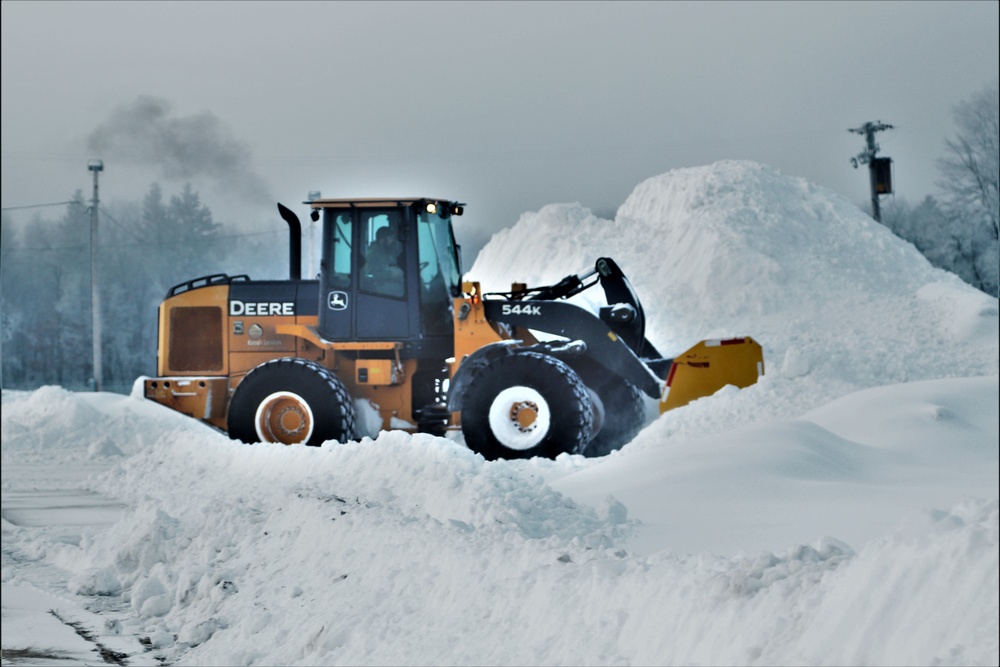
Wheel loaders are common snow-plow carriers because they combine mass, visibility, lift height and strong pushing capability. Articulated steering can make a wide blade manoeuvrable, but it also changes the relationship between the blade and rear of the machine during turns. Check overall swept width near parked vehicles, gate posts and loading docks.
A loader may also alternate between a plow and a bucket or pusher. If quick changes are frequent, coupler compatibility and hydraulic connector position matter operationally. The machine should still retain enough steering traction when the blade is full of heavy snow, especially on polished or icy surfaces.
Skid steers and compact track loaders
Skid steers are agile on paved yards, car parks and confined commercial sites. Their short wheelbase makes quick direction changes easy, while a compact track loader can provide more traction on loose or uneven surfaces. Both can be pushed sideways by a heavily angled blade if traction is limited.
Do not assume that a wider blade is automatically more productive because the loader can lift it. Effective performance depends on the machine’s ability to keep the blade moving without excessive wheel spin, track scrub or repeated steering correction. For the broader carrier checks, see the skid steer attachment guide.
Tractors
Tractors are widely used for municipal, estate, agricultural and property-maintenance snow work. Front three-point, loader-mounted and dedicated subframe systems can all be used depending on the machine. A tractor with a rear spreader can combine mechanical snow removal with material application, but the combined front and rear loads must remain within axle and tyre limits.
Backhoe loaders and utility machines
A backhoe loader offers useful mass and road mobility for snow operations. Utility and municipal machines may have dedicated front mounting plates and hydraulic functions designed for winter tools. The exact mounting geometry still needs checking because blade loads are primarily horizontal and can be severe during impacts.
04 / WIDTH & GEOMETRY
Nominal width is not the same as useful clearing width
The width printed in a brochure is normally measured with the blade in a reference position. Once a straight blade is angled, its projected width across the direction of travel becomes smaller. If the blade becomes narrower than the carrier’s tyres or tracks at the intended working angle, the machine can drive into uncleared snow and disturb the windrow on every pass.
A simple first check is to compare the carrier’s outside tyre or track width with the blade’s effective width at the normal windrowing angle. Then check the route itself: narrow gates, parked cars, loading docks, traffic islands and storage access can make a theoretically productive wide plow difficult to use.
Blade height and snow roll
Higher moldboards can carry and roll a larger volume of snow, but they also increase the frontal area and can reduce visibility. In light powder, snow can blow over a short blade at speed. In wet snow, a tall blade can hold a heavy moving mass that quickly increases pushing resistance. Height therefore needs to match snow volume and carrier capability.
Angling force
Angling a plow creates side thrust. The snow leaves the blade sideways, and the carrier has to react to that force through the tyres or tracks. On ice, a wide highly angled blade can steer the machine even when the operator holds the steering input straight. Reducing speed, reducing blade load, adjusting angle or changing the pass sequence can restore control.
Transport and parked width
Working width and transport width should be checked separately. An expandable or winged blade may clear a very wide path but need a folded position for transport. Confirm that the folded blade does not block lights, exceed local transport limits or project into adjacent traffic. Also make sure a parked attachment sits securely without unstable wings or cylinders exposed to damage.
Example: why a 3.0 m blade may not clear 3.0 m
A 3.0 m straight blade mounted on a 2.2 m wide loader looks generous when square. At a strong windrowing angle, the projected clearing width falls. If the operator also leaves a margin to avoid catching the windrow with the inside tyre, the practical clean-pass width becomes smaller again. This is why blade angle, carrier width and route layout belong in the same sizing calculation.
05 / HYDRAULICS & CONTROLS
Hydraulic functions: angle, wings, float and attachment control
A basic manual-angle plow may need no hydraulic function beyond the carrier’s lift circuit. Most professional machine-mounted snow plows, however, use hydraulic cylinders to angle the blade or move independent wings. The number of required functions should be checked before ordering the attachment.
Straight-blade angling
A double-acting cylinder arrangement moves the blade left and right. The carrier needs a suitable control valve and compatible couplers. Flow demand is usually intermittent rather than continuous, but the cylinders and hoses must be rated for the carrier pressure and protected from pinching through the full angle range.
V-plow and wing controls
Independent wings can require two double-acting functions or an attachment-mounted valve block controlled electrically from the cab. Confirm the control architecture rather than assuming the existing auxiliary lever will operate every mode. If the blade uses an electric selector, identify voltage, connector type and how the operator switches between functions.
Float
Float lets the blade follow the surface without the loader arms forcing a fixed height. The float function may be provided by the carrier hydraulics, the attachment linkage, or a combination of both. Correct use reduces the tendency to lift over low areas or dig aggressively into high spots. It is especially important on undulating yards and gravel surfaces.
Pressure is not a substitute for correct geometry
Increasing down pressure can improve scraping in a narrow set of conditions, but excessive force increases wear, drag and the risk of surface damage. Road-maintenance research treats blade angle, down pressure and edge material as a combined system. For loader-mounted plows, follow the attachment and carrier instructions rather than using hydraulic force to compensate for a worn edge or poor setup.
| Question | Why it matters |
|---|---|
| How many powered functions? | Determines valves, hoses and electrical selector requirements. |
| Maximum system pressure? | Cylinders, hoses and valve blocks must be rated accordingly. |
| Coupler size and location? | Affects connection, hose routing and contamination control. |
| Is true float available? | Important for following uneven surfaces without constant operator correction. |
| Can the hoses move through full angle? | Prevents stretching, pinching and contact with tyres or linkage. |
06 / CUTTING EDGES
Steel, carbide, rubber and polymer cutting edges
The cutting edge is the wear component that actually meets the road, yard or paved surface. There is no single best material for every route. The correct edge depends on whether the priority is aggressive scraping, long wear life, surface protection, reduced noise or efficient slush removal.
Steel
Steel edges are widely used because they are robust, relatively simple and provide positive scraping on suitable surfaces. They can be reversible or replaceable in sections. Wear should be measured before the edge becomes so thin that the moldboard, edge holder or bolt heads begin contacting the ground.
Carbide
Carbide inserts or carbide-edged systems are used where long wear life and hard-pack scraping are important. They can be more expensive and may transfer impact differently from a more compliant edge. Route condition, raised covers and surface type need consideration before choosing a very hard edge.
Rubber and polymer
Rubber or polymer edges can reduce marking and noise and may follow some surfaces more gently. They are often useful for wet slush or locations where aggressive steel contact is undesirable. Their wear behaviour can differ significantly between wet, dry and abrasive surfaces.
Combination systems
Some winter-maintenance systems use multiple edges or mixed materials to separate the job of scraping from the job of squeegeeing slush. For a machine-mounted attachment, only use combinations approved for the actual blade because edge height and stiffness affect trip geometry and ground contact.
The Minnesota Local Road Research Board notes that edge material, angle and down pressure all influence removal performance, wear and surface impact. That is a useful selection principle even when the attachment is a loader blade rather than a highway-truck plow: do not judge the edge independently from the complete setup.
07 / OBSTACLE PROTECTION
Trip edges, full-trip moldboards, shoes and oscillation
Snow hides kerbs, drains, speed bumps, raised covers and other objects that were obvious before the storm. A trip system is intended to reduce the severity of some impacts, but it is not permission to hit hidden obstacles at speed. Different mechanisms react in different ways.
Trip edge
Only the lower edge or lower section rotates when it encounters an obstacle. The main moldboard can stay relatively upright, which helps keep the snow load contained. Inspect pivot pins, springs, stop surfaces and edge return action regularly.
Full-trip blade
The moldboard rotates forward around its mounting when the trip load is exceeded. This can release a larger obstruction but also changes what happens to the snow being pushed. The blade must return freely and the springs or elastomer system must match the manufacturer’s adjustment.
Independent sections
Sectional plows allow only the impacted part of the edge or moldboard to move. This can reduce the disturbance to the rest of the blade on uneven surfaces. More sections also mean more hinges and wear components to inspect.
Skid shoes and caster wheels
Shoes can raise the edge slightly off gravel, block paving or another surface where direct scraping is undesirable. They also reduce the ability to scrape closely. On paved roads, some operators prefer the edge itself to follow the surface while shoes are used only for specific conditions. Use the attachment maker’s setting guidance.
Oscillation and lateral float
A plow mounted rigidly to a loader coupler may not stay parallel to a crowned or twisted surface as the machine moves. An oscillating headstock or lateral float allows limited roll movement so both ends of the blade can stay closer to the surface. Check that the freedom is controlled and does not allow the attachment to strike tyres, linkage or hydraulic hoses.
08 / CONDITIONS
Dry snow, wet snow, slush, hard pack and gravel
The same plow can behave very differently from one storm to the next. Snow temperature, moisture, depth and previous traffic determine how readily the material rolls off the moldboard and how much pushing force is required.
Light dry snow
Powder moves easily at low depth, but it can become a visibility problem. At higher travel speed the snow cloud can rise over or around the blade and obscure obstacles. Wind can also return material to the cleared lane. A route that looks efficient at the start of a storm may need more frequent passes when drifting begins.
Wet heavy snow
Wet snow is dense and can create large loads on the moldboard. It may stick to the blade rather than roll cleanly, particularly around freezing. Reduce the amount carried in each pass if traction or steering control drops. A wider blade does not help if the carrier cannot keep the snow moving.
Slush
Slush needs close surface contact and good discharge. Flexible edges can be effective in specific slush conditions, while worn or poorly pitched edges leave a film behind. If de-icing material will be applied afterwards, removing as much loose material as practical helps the treatment reach the surface.
Compacted snow and bonded ice
A front snow plow is primarily a snow-moving attachment, not an unlimited ice scraper. Hard pack can require a different edge, lower speed, additional treatment or a dedicated scraper approach. Do not compensate by forcing the blade down beyond its intended operating condition.
Gravel and unpaved surfaces
Early-season plowing on unfrozen gravel can move large amounts of aggregate into the verge. Shoes, reduced down pressure, a slightly raised edge or different timing may be appropriate. Once the base is frozen, closer plowing can become practical. The route owner should define the acceptable finish rather than applying a paved-road setting everywhere.
09 / ROUTE STRATEGY
How to plan passes instead of simply pushing snow
The fastest individual pass is not necessarily the fastest completed site. Rehandling the same pile, blocking the next lane or filling the only available storage corner early can add far more time than a slightly slower first pass. A productive plan starts before snowfall.
Map obstacles before they disappear
Mark kerbs, islands, bollards, drains, speed bumps, expansion joints, fire hydrants and low walls. Record which items can be crossed and which must be avoided. Reflective poles or a route map can prevent impact after a storm covers the reference points.
Decide where snow is allowed to stay
Keep piles away from junction sight lines, pedestrian crossings, emergency routes, doorways, loading docks and drainage paths. Also think about meltwater: a convenient pile can create repeated freeze-thaw ice if it drains across a cleared route.
Open the route, then widen it
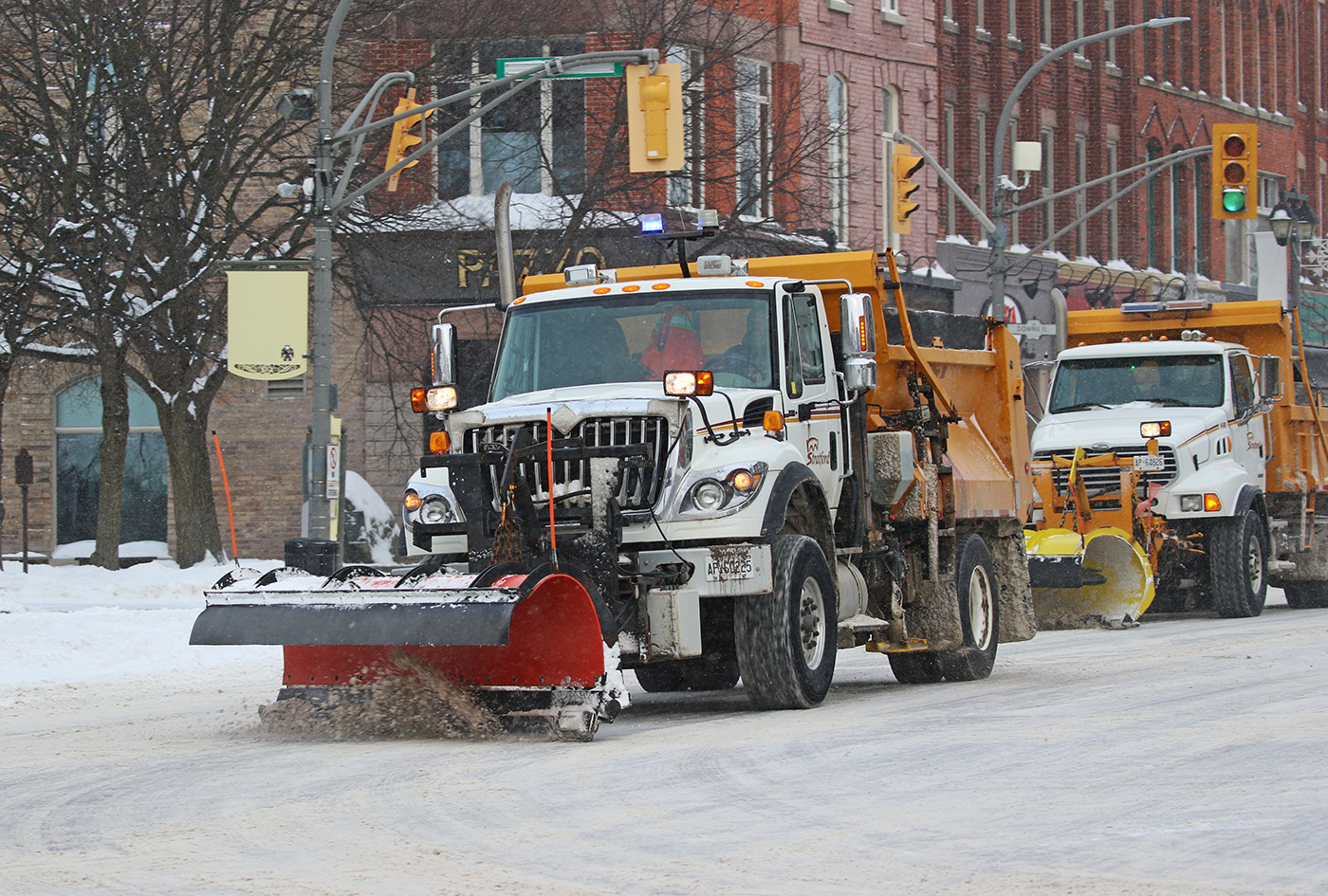
In deep snow, a narrow opening pass can be more controllable than trying to clear full width immediately. Subsequent passes move smaller loads to the final edge. A V-plow can be useful where the first pass must split a drift, while a straight blade can windrow efficiently once a path is open.
Use the blade angle to control the windrow
More angle usually improves sideways discharge but reduces effective width and increases lateral force. Less angle carries more snow forward but can spill from both ends. Adjust the blade as the site changes instead of leaving one setting for the entire route.
Back-drag only where the design permits it
Clearing directly in front of doors, loading bays or parked vehicles can require pulling snow backwards. Some blades have back-drag edges or geometry designed for this duty. Others do not scrape effectively in reverse. Check the attachment instructions before treating back-dragging as a primary function.
Stacking snow
A loader can lift and stack snow above the height possible with a low truck plow, but raising a full blade also changes machine stability and visibility. Do not use the plow as a bucket if the design is not intended to carry a suspended load. For bulk relocation, a 4-in-1 bucket, snow bucket or pusher may be more appropriate.
10 / SAFETY
Visibility, speed, traffic and hidden obstacles
Snow removal often happens at night, in falling snow and around vehicles that are still using the site. The attachment can be wider than the carrier, the windrow can hide fixed objects, and snow clouds can reduce visibility. These conditions make site planning and machine lighting part of attachment selection.
- Know the blade corners. A wide angled blade sweeps a larger path during turns than the carrier body.
- Control speed. Use a speed that allows the operator to see obstacles, maintain steering authority and give the trip mechanism time to react. Highway plow research cannot be copied directly to a loader in a car park; the site governs the safe speed.
- Keep people clear. Snow, ice, gravel and hidden debris can be thrown from the moldboard. Maintain an exclusion area around the machine.
- Use suitable lighting. The raised or angled blade should not block required work lights. Snow glare and blowing powder can make poorly positioned lights worse rather than better.
- Watch reversing areas. Commercial snow work involves frequent reversing. Cameras, mirrors, beacons and site separation help reduce risk where pedestrians or traffic remain present.
- Do not rely on trip protection. A trip edge reduces some impact loads; it does not make high-speed collisions acceptable.
When the site is open to traffic, the snow-removal plan should define travel direction, warning measures and where cleared material may be placed. A mechanically suitable attachment is only one part of a safe winter-maintenance system.
11 / SERVICE
Snow plow maintenance and wear points
Snow plows work in water, salt, grit and repeated impact cycles. Seasonal inspection should therefore focus on both wear and corrosion. A blade that is parked for most of the year can deteriorate while apparently doing nothing.
Before every shift
- Check that the carrier coupler or mounting pins are fully locked.
- Inspect hoses for abrasion, ice damage, tight bends and leaks.
- Look for missing edge bolts, broken springs, damaged trip sections and cracked welds.
- Confirm wings or angle cylinders move without interference.
- Check that marker poles and any lights are intact and visible.
- Remove packed ice that prevents float, oscillation or trip movement.
Cutting-edge wear
Measure wear rather than waiting until performance becomes obviously poor. An uneven edge can make one side of the plow carry excessive pressure and leave streaks. Replace or rotate sections according to the design before the attachment structure reaches the ground.
Pivots and trip components
Grease specified pivots at the required intervals. Check pins, bushes, spring anchors, hinge tubes and stops. Excessive free play changes blade geometry and can cause shock loads when the direction reverses or the trip system returns.
Hydraulic system
Clean hydraulic couplers before connection and fit dust caps when the blade is stored. Inspect cylinder rods for corrosion and damage because winter salt and grit quickly attack exposed surfaces. A slow wing or angle function can indicate low oil flow, a damaged cylinder, restriction, air, contamination or a mechanical bind; diagnose the cause rather than simply increasing pressure.
End-of-season storage
Wash off salt and dirt, allow the attachment to dry, repair coating damage and protect bare steel. Store the plow on stable supports so the cutting edge and hydraulic connectors are not sitting in standing water. Relieve stored hydraulic pressure and position the cylinders according to the manufacturer’s storage guidance.
12 / ALTERNATIVES
Snow plow vs snow pusher, snow blower, sweeper and spreader
Snow plows are excellent when material can be moved sideways or to a nearby storage edge. Other attachments become more efficient when the site requires containment, long-distance relocation, throwing snow over a bank, sweeping a thin layer or treating residual ice.
| Attachment | Best suited to | Main advantage | Main limitation |
|---|---|---|---|
| Snow plow | Roads, lanes, yards with side storage | Fast continuous clearing and directional control | Snow remains beside the route |
| Snow pusher | Large car parks and stockpile work | Contains a large volume while pushing forward | Less suited to continuous windrowing on narrow roads |
| Snow blower | Deep snow, narrow routes, high banks | Throws material away from the cleared path | More mechanical and hydraulic complexity |
| Sweeper / broom | Light snow, final cleanup, paved areas | Good finish on thin loose material | Not a bulk-snow tool |
| Salt & sand spreader | Residual ice and traction treatment | Treats the surface after mechanical removal | Does not move accumulated snow |
A mixed fleet often uses more than one tool. For example, a plow opens and windrows the route, a pusher consolidates parking-lot snow into a stockpile, and a spreader treats the cleared surface. See the broader snow and ice management application guide and snow, ice and road-maintenance attachment category for adjacent tool families.
13 / BUYING & RFQ
What to specify before requesting a snow-plow quote
A useful quotation request describes the carrier, route and snow conditions rather than asking only for “a 3 metre plow.” The supplier can then confirm whether the blade, mounting frame, cylinders and cutting edge suit the job.
- Carrier: make, model, operating mass, tyre or track configuration and front coupler or mounting system.
- Route: road, yard, parking area, estate, industrial site or mixed route; include narrowest access and typical turning space.
- Surface: asphalt, concrete, paving, gravel or mixed surfaces, including speed bumps and raised covers.
- Snow: typical depth and whether wet heavy snow, drifting or compacted material is common.
- Blade type: straight, V, winged, expandable or sectional; explain why that configuration is wanted.
- Width: carrier width plus the effective clearing width required at the normal operating angle.
- Hydraulics: available circuits, pressure, couplers and electrical controls.
- Trip system: trip edge, full trip or sectional design, including adjustment and replacement parts.
- Cutting edge: desired material, bolt pattern, section length and alternative edge options.
- Float / oscillation: confirm how the blade follows uneven or crowned surfaces.
- Lighting and markers: whether the attachment obscures machine lights or needs its own markers/lighting.
- Parts: edge sections, springs, pins, bushes, hoses, cylinders and local service availability.
Buying used
A used snow plow deserves more than an empty hydraulic movement test. Inspect the frame for twist, cracked welds and repaired impact points. Check cutting-edge wear, spring anchors, trip hinges, angle pivots, cylinder rods and the mounting interface. Confirm that both sides sit at the same height on a flat surface and that the blade returns correctly after tripping.
Look closely at improvised welding around the mounting frame. A repair may be perfectly serviceable, but the load path should be understood and the geometry still needs to match the carrier. Verify that the blade model, serial information and replacement edge pattern are still supported before buying a very old unit.
Example RFQ
“We need a front snow plow for a 7.5 t wheel loader with 2.25 m outside tyre width and hydraulic quick coupler. The machine clears an asphalt industrial yard with 3.0 m gates, speed bumps and repeated wet snow events. We need hydraulic left/right angle, float, trip protection and an effective clearing width that still covers the tyres at the normal windrowing angle. Please confirm attachment mass, working and transport width, hydraulic connections, edge options, trip design and recommended spare wear parts.”
14 / DIRECTORY
15 / FAQ
Frequently asked questions about snow plows
What is the best snow plow type for a loader?
There is no single best type. A straight blade is simple and effective for continuous windrowing, a V-plow handles mixed conditions and deeper first passes, and winged or expandable designs can improve productivity on larger variable-width sites. Match the blade to the route, carrier and snow conditions.
Should a snow plow be wider than the machine?
Usually the effective clearing width at the normal operating angle should at least cover the outside tyre or track width. Nominal blade width alone is not enough because angling reduces projected width.
Why does a loader slide sideways when plowing?
An angled blade creates lateral force. Heavy wet snow, a wide blade, aggressive angle, low traction or excessive speed can make the blade steer the carrier sideways. Reduce the load or angle and restore traction rather than forcing the pass.
What is the difference between a snow plow and a snow pusher?
A snow plow normally redirects snow sideways and is efficient for windrowing along roads and routes. A snow pusher contains snow between side plates and is designed to carry a large volume forward toward a stockpile.
When is a V-plow better than a straight blade?
A V-plow is useful when the machine has to split drifts, work in variable snow depth, scoop material or change between several blade positions on the same route. A straight blade is simpler when continuous windrowing is the main job.
What does a trip edge do?
A trip edge allows the lower part of the blade to rotate or release when it meets an obstacle above a set load. It can reduce some impact loads, but it does not protect against every obstruction or justify high-speed impacts.
Is a full-trip plow the same as a trip-edge plow?
No. With a full-trip design, much or all of the moldboard rotates forward. With a trip-edge design, mainly the lower edge or section moves. The two systems react differently to obstacles and snow load.
Is a rubber cutting edge better than steel?
Not universally. Rubber can reduce noise and surface marking and work well with slush, while steel generally gives firmer scraping. Surface type, snow condition, wear rate and the plow design should determine the edge.
When should carbide cutting edges be used?
Carbide is typically chosen where long wear life or aggressive hard-pack scraping is important. The very hard edge can behave differently on raised objects and sensitive surfaces, so use the blade maker's approved edge options.
How much down pressure should I use?
Use the setup specified for the plow and carrier. Excessive down pressure increases drag, wear and the risk of damaging the surface. Float is often preferred for normal snow removal on uneven surfaces.
Why does my snow plow leave snow on one side?
Possible causes include uneven cutting-edge wear, incorrect blade pitch, a twisted mounting frame, uneven tyre pressure, a float or oscillation problem, packed ice in the linkage or an uneven surface. Inspect the geometry before adding more pressure.
Can a snow plow clear packed ice?
A plow can remove loose or partly compacted material, but bonded ice may need a more suitable cutting edge, slower scraping method, de-icing treatment or dedicated scraper. Do not force a standard blade beyond its intended duty.
Can I plow gravel with the same setup as asphalt?
Often not. On unfrozen gravel, aggressive edge contact can move aggregate into the verge. Shoes, reduced pressure or a raised edge may be appropriate until the base is frozen. Follow the route owner's required finish and the plow instructions.
What should be checked before each shift?
Check mounting locks, cutting-edge bolts, trip springs or sections, pivots, hoses, cylinders, marker poles and lighting. Remove packed ice that prevents the blade from floating, tripping or angling freely.
What should I inspect when buying a used snow plow?
Check frame alignment, weld repairs, cutting-edge wear, pivots, bushes, spring anchors, cylinders, hoses, trip action and the coupler. Confirm model identification and that replacement wear parts are still available.
What information should I send when asking for a quote?
Send the carrier model and width, mounting interface, route type, narrowest access, surface, typical snow conditions, desired blade configuration, hydraulic functions and the effective clearing width you need at the intended working angle.