
ATTACHMENT SELECTION GUIDE
4-in-1 Buckets
One bucket for loading, dozing, grading and gripping. Understand the trade-offs, match the hydraulics and choose a combination bucket for the work you actually do.
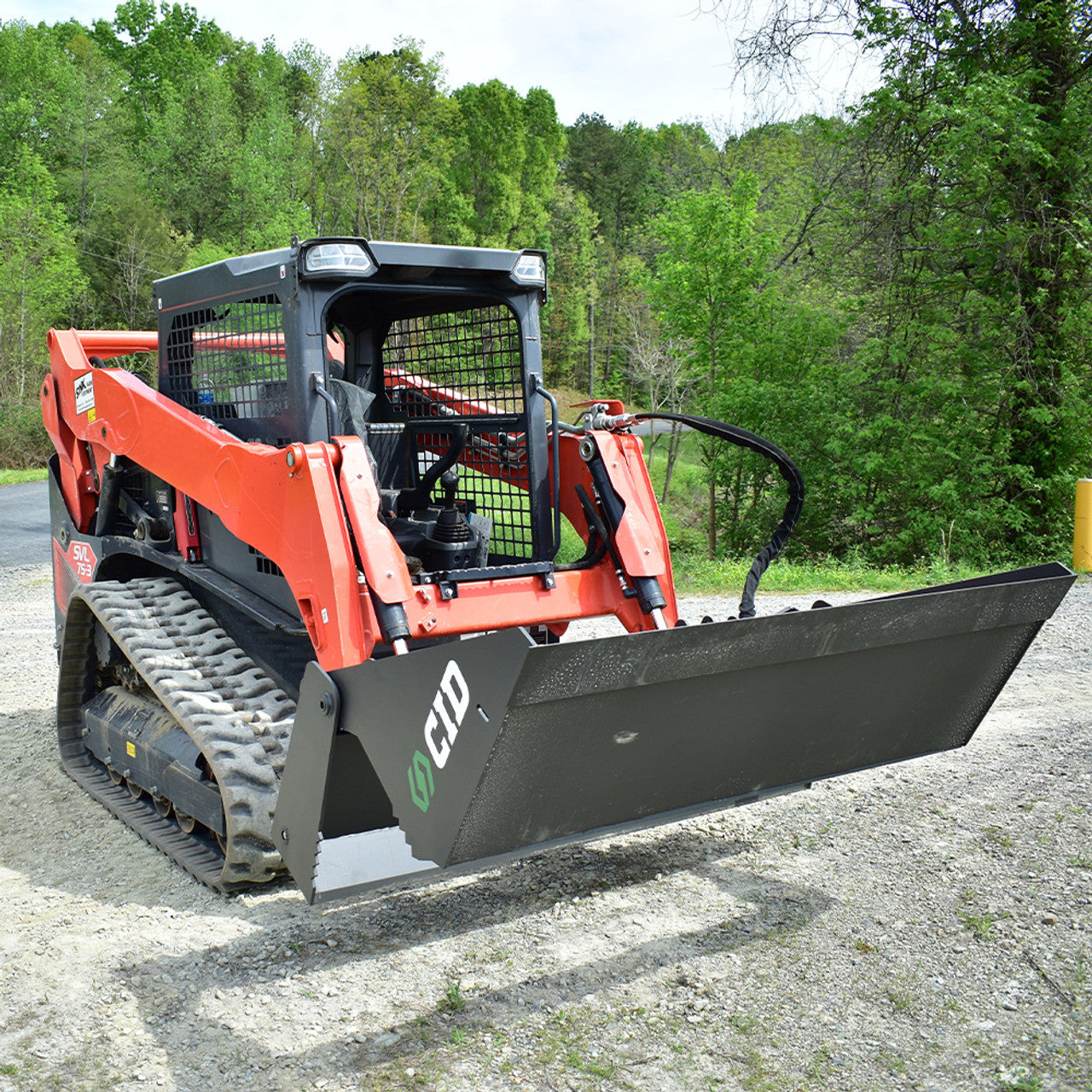
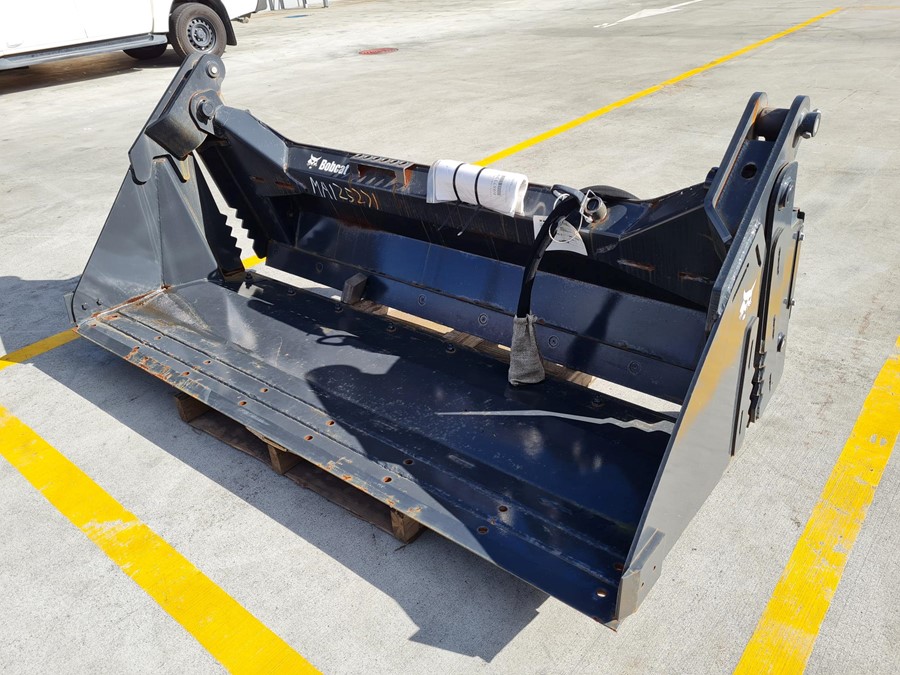
A 4-in-1 bucket has a fixed rear section and a hydraulically opening front section. Closed, it works as a loader bucket. Open, it exposes the rear blade and creates a jaw for controlled material handling. The mechanism adds versatility, but also weight, maintenance points and a different load geometry.
01 / WORKING PRINCIPLE
What does a 4-in-1 bucket actually do?
The name describes a group of functions, not a universal technical specification. One manufacturer may count grading separately; another includes it with dozing and counts bottom dumping instead. Compare the opening mechanism, approved uses and working edges rather than assuming every bucket advertised as four-in-one has identical capabilities.
1. Load, carry and tip
With the front section closed, the bucket scoops and retains suitable loose material. The loader’s lift and tilt functions perform the normal filling, carrying and tipping movements. The extra clamshell mechanism is not needed for every loading cycle.
2. Doze and push
Opening the front exposes the fixed rear blade. This can push and spread loose material where the bucket design permits it. The useful pushing width, cutting-edge visibility and resistance to side loading remain different from those of a dedicated dozer blade.
3. Grade and back-drag
The working edges can distribute and trim material using the approved bucket positions. Opening the front can improve the view of the rear edge. Edge straightness, loader control and ground conditions determine the finish; the bucket does not automatically maintain a surveyed grade.
4. Grip and collect
The moving front closes against the rear section to hold suitable objects or gather small piles. Jaw opening and contact shape matter as much as closing force. A secure grip on one object does not establish suitability for every log, stone or piece of demolition debris.
Bottom dumping is an additional useful movement
On designs that allow it, opening the front releases the load through the bottom without the same forward tipping movement as a conventional bucket. This can help when placing material over a container side. It does not increase loader lift height or remove the need to check discharge clearance, load stability and the entire opening path.
The front section is commonly moved by two cylinders, but some compact tractor designs use one. Cylinder count alone is not a strength or quality rating. The load path through the shell, hinges and linkage is what matters.
02 / WHERE IT FITS
When a combination bucket makes sense
The strongest case is a job that changes repeatedly. A landscaping contractor might load topsoil, spread a small pile, retrieve an awkward branch and tidy the work area in one visit. Avoiding several attachment changes may be worth more than maximizing the capacity of each individual scoop.
For grading and site preparation, judge how much time is spent moving material and how much is spent producing the final surface. A combination bucket can be useful in preparation and cleanup even where the last pass needs a different tool. For material handling, distinguish routine bucket loading from gripping irregular objects and from suspended lifting: these are different load cases.
Choose around the dominant material
Loose topsoil, aggregate, mulch and similar materials create different loading and retention demands. Wet material can be considerably heavier than the same bucketful of light dry material. Sharp debris adds a puncture and abrasion risk around hoses, cylinders and seals. Long objects may project outside the bucket and shift the centre of gravity even when their mass seems modest.
Write down a normal day’s work before comparing products. Identify the dominant material, typical travel distance, access width, container height and frequency of tool changes. Then describe the hardest occasional task separately. Buying for one rare extreme can leave the machine carrying unnecessary attachment weight for most of its working life.
Where a dedicated attachment is a better starting point
Continuous stockpile loading is a different problem from mixed site work. If the jaw is seldom used, compare a simple loader bucket with an appropriate capacity and wear package. For bulky branches and irregular debris, compare grapple buckets. For broad surface finishing, look at land levelers or the appropriate grading attachment for the carrier.
A combination bucket should not be selected as a substitute for a rock breaker, demolition processor, personnel platform or general-purpose crane attachment. Its versatility comes from rearranging bucket geometry, not from adding those separate capabilities.

03 / MACHINE MATCH
Which machines can use a 4-in-1 bucket?
Carrier approval is model-specific. A mount that connects physically is only one part of the check: installed mass, load centre, hydraulic controls, visibility and clearance also have to work together. Obtain the specification for the exact bucket, mounting arrangement and machine rather than relying on a machine-weight category alone.
| Carrier | Important checks | Common selection mistake |
|---|---|---|
| Skid steers | Approved quick-attach interface, usable operating capacity, cutting-edge visibility and auxiliary controls. | Selecting a wide, heavy bucket solely because the attachment plate fits. |
| Compact track loaders | Bucket width relative to tracks, attachment rating, material mass and intended ground conditions. | Treating traction as proof of unlimited pushing or lifting ability. |
| Wheel and articulated loaders | Coupler or pin geometry, linkage clearance, permitted bucket application and capacity in the stated machine configuration. | Using a straight-ahead figure without checking the manufacturer’s articulated-machine conditions. |
| Backhoe loaders | Front-loader linkage, mounting type, clamshell circuit, rollback and dump envelope. | Confusing a front-loader combination bucket with an attachment for the rear excavator arm. |
| Tractors with front loaders | Loader approval, actual lift geometry, specified ballast and an appropriate third-function or diverter arrangement. | Matching by engine power while ignoring loader capacity and control requirements. |
| Telehandlers | Bucket-duty approval, correct carriage and the applicable attachment load chart throughout reach and lift. | Applying the machine’s headline lifting capacity to an unapproved bucket configuration. |
Mounting details that cannot be assumed
Confirm the exact quick-attach system or pin dimensions, not just a familiar description such as universal, Euro or loader mount. Check engagement, lock indication, wear limits and the prescribed attachment test. The jaw must clear the machine, hoses and any adapter throughout the permitted movements. The quick-coupler guide explains why an interface label is not a complete compatibility approval.
An adapter can solve a mounting mismatch while creating a new load problem. It adds mass and usually moves the bucket further from the machine. Recheck the complete installation rather than transferring the original capacity claim to the new arrangement. Adding a tilt adapter also changes hydraulic and clearance requirements.
04 / SIZE AND PAYLOAD
Choose width, capacity and mass together
Width: more than covering the tyres
On many loader applications the cutting width needs to cover the machine’s working footprint, but access restrictions and the manufacturer’s approved combinations still govern selection. Check gates, trailers and confined work areas using the widest part of the installed bucket. Some catalogues state inside width; others state cutting width or overall width. Those measurements are not interchangeable.
A wider bucket can move more light material or finish a broader strip. It can also be heavier, harder to fill in resistant material and less convenient near obstacles. Ask whether the operator can see the important edges from the normal seated position, not only from beside the machine.
Capacity: compare like with like
Struck capacity describes a level-filled bucket volume under the stated measurement method. Heaped capacity includes a defined heap above it. Compare figures using the same basis and note whether the bucket includes teeth, a raised spill guard or another option affecting the configuration. A larger catalogue volume is not automatically a larger permitted working load.
Use the density of the actual loose material to estimate its mass. Moisture, particle distribution, compaction and contamination can change that estimate. A light-material bucket that works well with mulch may be unsuitable when filled to the same level with dense aggregate.
Worked example: volume is not payload
Illustrative assumptions, not a machine rating: a 0.35 m³ material load at 1,600 kg/m³ weighs 560 kg. Add a 300 kg bucket and a 40 kg adapter, and the simple combined mass is 900 kg.
That calculation identifies the mass to investigate. It does not approve the lift or justify subtracting weights from an unrelated capacity figure. The machine’s rating basis, load centre, attachment arrangement and working position must still be checked.
Payload, breakout force and clamping force are different
Breakout force describes a machine or linkage force under specified conditions. Clamping force describes the jaw mechanism at a stated pressure and geometry. Neither is a substitute for the carrier’s approved working load or the bucket’s permitted handling duty. A bucket may grip an object that the complete machine cannot safely transport.
Compare empty installed mass as carefully as capacity. Heavy-duty reinforcement may be justified in an abrasive application, but its benefit should be assessed against the payload and manoeuvrability needed for normal work. The best bucket is not necessarily the widest or heaviest one available.
05 / HYDRAULICS AND CONTROLS
What hydraulic connections are required?
The jaw normally uses a double-acting hydraulic circuit: pressure is directed to one side of the cylinder or cylinders to open it and to the other side to close it. This is separate from the loader’s ordinary lift and tilt movements. Confirm the required controls, couplers and hose arrangement for the particular machine.
High flow is not the starting requirement
A cylinder-operated clamshell is not a continuously driven hydraulic motor. Supply flow influences opening and closing speed; available pressure and mechanism geometry influence force. More flow is not automatically useful. It can make movement difficult to control if the circuit and attachment are not designed for it. Select the specified flow and pressure, not the machine’s highest setting.
A conventional cylinder-only bucket does not normally need a separate motor case-drain line. Model-specific valves or additional mechanisms may change the plumbing, so use the actual hydraulic diagram. Do not apply a generic three-hose motor-attachment checklist without establishing what each connection does.
Third function or diverter?
A tractor loader may use a separate third-function valve or an approved diverter arrangement. A diverter can redirect an existing control rather than provide completely independent operation. Ask which movements can be made together and how the operator changes functions. An installation that technically opens the jaw may still be inconvenient for the intended loading cycle.
Relief protection, coupler pressure rating and return-path restrictions must match the circuit. Some buckets include load-holding valves; others use different arrangements. Their presence does not turn the bucket into a universally approved lifting device. Never raise relief pressure to compensate for a poor grip or an undersized attachment.
Check hoses through the whole working envelope
Inspect routing with the jaw open and closed and through the approved lift, rollback and dump positions. Hoses need enough freedom to move without stretching, rubbing, entering the jaw or becoming trapped behind the mount. Protect cylinder rods and fittings from material falling behind the bucket. A connection at rest is not evidence of adequate clearance in motion.
Clean hydraulic connections and follow the carrier’s pressure-release procedure before connecting or disconnecting. Do not open a fitting to release trapped pressure as an improvised shortcut. Suspected high-pressure leaks require isolation and competent inspection; never search for them with bare hands.
06 / DETAILS THAT MATTER
Cutting edges, jaw geometry and wear protection
The front edge, rear dozing edge and any back-dragging edge perform different jobs. Check which are replaceable, reversible or integral to the shell and which options are approved. A quotation saying cutting edge included should identify the edge rather than leave you guessing which working surface is protected.
| Choice | Useful when | Check before ordering |
|---|---|---|
| Smooth cutting edge | Clean pickup, spreading and surface finishing are frequent tasks. | Wear material, replacement method and suitability for the surface. |
| Teeth or removable tooth bar | Approved digging in resistant material needs better penetration. | Effect on grading finish, overall projection and jaw clearance. |
| Serrated side gripping edges | The intended irregular material benefits from additional contact features. | Contact position, object damage and the permitted gripping duty. |
| Additional wear protection | Abrasive material creates a demonstrable wear problem. | Added mass, access to service points and replaceability. |
| Low-profile or visibility-focused geometry | Seeing the cutting edge is important for control. | Real visibility from the cab and capacity compromises. |
Opening size is only one dimension
A wide jaw opening helps accept material, but it does not show how deeply the object can sit or where the jaws will contact it. Examine the closing path and the useful contact area for the actual material. A rounded stone, a branching piece of timber and a compact pile of soil interact with the same opening differently.
Inspect how loads pass through the hinge pins, shell corners, cylinder mounts and mounting plate. These details matter more than an isolated steel-thickness claim. Compare guards and the accessibility of grease points, hose connections and replaceable bushings. The mechanism should be serviceable without improvised lifting or support arrangements.
07 / ALTERNATIVES
4-in-1 bucket versus dedicated attachments
Compare the result of the whole job, not only how many functions an attachment offers. A more specialized tool can be the better choice when the same task repeats for hours. Conversely, transporting and changing several tools can be inefficient for short, varied jobs with restricted space.
| Alternative | Why consider it? | What the 4-in-1 adds |
|---|---|---|
| General-purpose loader bucket | A simpler starting point for repeated filling, carrying and tipping. | An opening front for gripping, blade work and permitted bottom dumping. |
| Grapple bucket | Dedicated retention geometry for bulky and irregular material. | A rear dozing edge and a different clamshell working arrangement. |
| Land leveler | A tool designed around surface preparation and levelling. | The ability to carry material and grip suitable objects between finishing tasks. |
| High-tip bucket | A dedicated discharge arrangement where container clearance is the dominant issue. | Gripping and blade functions; bottom dumping is not equivalent to high-tip geometry. |
| Skeleton bucket | Separating larger material from fines through openings in the bucket. | A solid-shell loading and clamping arrangement rather than intentional screening. |
| Excavator grading bucket | Finishing from an excavator arm with a different linkage and working method. | Loader-based multi-function work; these are not direct substitutes on the same mount. |
For pallets, use an approved pallet-fork arrangement, not the clamshell edges as improvised fork tines. Optional fork equipment on some combination buckets has its own rating and installation requirements. Its existence does not make every combination bucket suitable for pallet work.
08 / WORKING APPROACH
Assess performance in real working cycles
This guide supports selection, not operator training. Follow the machine and attachment instructions for the approved positions, loading method, exclusion zone and operating limits. A demonstration should be carried out by a competent operator on suitable ground with the actual type of material.
Loading and carrying
Judge filling behaviour, material retention and visibility with the jaw properly closed. Watch for gaps at the edges and material collecting around the hinge. Use the carrier’s prescribed travelling position and route. A load that fits inside the shell can still be too heavy, unstable or poorly positioned for the machine.
Spreading and finishing
Assess the finish at a realistic pace and compare several passes, not only a carefully prepared demonstration strip. Check whether the operator can see the intended working edge and control material release without abrupt jaw movement. Edge wear or uneven closure can leave ridges that a new cutting edge alone may not correct.
Gripping and placement
Check the permitted object size and handling method before the trial. Consider how the object is supported as the jaws close, how its centre of gravity changes and whether it can slide, roll or escape. Do not use the open jaw as a pry bar or twist the attachment sideways to free embedded material.
Dump clearance
Evaluate both conventional tipping and permitted bottom dumping against the real receiving container. Consider the bucket body, front-section sweep, falling material and safe machine position. Reaching over a side wall does not mean there is room to open the bucket or retract without contact.
Hazards specific to the opening front
The hinge and closing edges create crushing zones that remain dangerous when the machine appears stationary. Stored hydraulic energy and unsupported components can cause movement during inspection. Lower and isolate equipment as instructed and use the specified mechanical support arrangements before maintenance. Never rely on the control lever or hydraulic pressure alone to keep an opening safe.
09 / OWNERSHIP
Maintenance, wear and common faults
Use the actual service schedule, lubricant specification, fastener torques and wear limits. There is no universal greasing interval or acceptable pin clearance for every combination bucket. Keep inspection records so that increasing play, repeated edge damage or cylinder problems are identified as trends rather than isolated repairs.
Pre-use inspection priorities
Check the attachment lock, mounting plate, hinge pins and retainers, cylinder connections, exposed rods, hose routing and working edges. Look for fresh cracks, loose fasteners, missing guards and damage near earlier repairs. Verify that identification and warnings remain legible. Stop using equipment with a suspected structural or hydraulic defect until it has been assessed.
Remove obstructing material only after the equipment has been made safe under the relevant procedure. Inspect the moving section in the specified supported position, including areas hidden when it is closed. Cleaning is an opportunity to find faults, not a reason to enter an unsupported jaw opening.
| Symptom | Possible explanations | Next check |
|---|---|---|
| Jaw closes unevenly | Obstruction, worn pivots, edge mismatch, distortion or a mechanism fault. | Inspect the supported assembly; do not force it straight with extra pressure. |
| Jaw drifts after the control is released | Internal leakage or a valve/cylinder issue, depending on circuit design. | Stop load handling and have the circuit diagnosed competently. |
| Slow or abrupt jaw movement | Supply settings, coupler restriction, hydraulic fault or mechanical resistance. | Check specified setup and connections before changing settings. |
| Persistent material leakage | Worn edges, incomplete closure, trapped material or distorted shell geometry. | Check the complete closing line rather than replacing one edge blindly. |
| Repeated hose damage | Incorrect length or routing, missing protection or interference during movement. | Review the complete working envelope, not only the parked position. |
| Poor surface finish | Uneven wear, play, unsuitable edge configuration or control limitations. | Compare edge straightness and machine control with the intended finish. |
Repair decisions should preserve the designed geometry and load path. Unapproved welding, cylinder substitutions or altered stops can change how forces enter the shell and hinge. Ask for an approved repair method where damage is structural. Check replacement-part availability before purchase, particularly for cylinders, pivot components and model-specific cutting edges.
10 / PROCUREMENT
How to compare quotes and inspect a used bucket
Send a specification, not just a width
State the carrier make, exact model, loader arrangement and mounting interface. Include the intended materials, typical fill, task mix, access limits and required discharge arrangement. Ask for installed mass including options, overall and cutting width, capacity measurement basis, jaw opening, hydraulic requirements and the approved carrier combinations.
Request a clear list of included items: hoses, couplers, guards, mounting hardware, cutting edges and any valve block. Identify optional items separately. A lower headline price is not a meaningful saving when the necessary mounting and hydraulic installation are excluded.
A representative acceptance trial
Agree on the tasks to demonstrate: loading the normal material, carrying it over the intended route, spreading it, gripping an approved representative object and discharging into the actual type of container. Evaluate controllability, visibility, retained load and finished surface. Do not use an improvised overload test to prove that the bucket is strong enough.
Used-equipment checks
Confirm the manufacturer, model and serial identification before assessing fit or ordering parts. Inspect the attachment interface for wear and distortion, both shells for straightness, hinges for play and the areas around cylinder mounts for cracks or undocumented repairs. Look beyond fresh paint: it does not establish condition.
Ask to see the mechanism operate in a safe demonstration and obtain any available service and repair history. A jaw that opens and closes without a load may still have worn alignment components or internal leakage. Have doubtful structures and hydraulic components inspected by an appropriately competent person.
Compare ownership cost against real time saved
The economic question is not whether four functions sound cheaper than four attachments. It is whether the combination improves the work you actually do after accounting for purchase, installation, wear parts, maintenance, transport and any capacity penalty.
Planning example: assume a job avoids six attachment changes of three minutes each. That is 18 minutes saved on that job. Subtract any extra time caused by slower loading or finishing before assigning a value to the saving. These are hypothetical inputs, not a performance promise or a recommended operating target.
Keep the assumptions visible when comparing quotes. A contractor visiting many small sites may value fewer tool changes differently from an operator loading the same material all day. The supplier should help resolve the technical fit; your recorded task mix determines the commercial value.
11 / DIRECTORY
12 / QUESTIONS AND ANSWERS
Frequently asked questions about 4-in-1 buckets
What are the four functions of a 4-in-1 bucket?
The functions are commonly grouped as loading, dozing, grading and gripping. Some suppliers count bottom dumping separately or combine grading with dozing. The number is a descriptive label; compare the actual mechanism and approved working modes.
Is a combination bucket the same as a 4-in-1 bucket?
Usually those names refer to the same opening-front loader-bucket family. Multi-purpose bucket and clamshell bucket are also used, but terminology is not fully consistent. A suspended clamshell grab is a different attachment, despite the similar word.
Does it need a high-flow hydraulic system?
Not as a general requirement. The jaw is normally operated by cylinders, and the required circuit must provide the specified flow, pressure and control. Excess flow is not a substitute for suitable capacity or grip geometry.
Can I fit one to my tractor?
Only where the tractor-loader and bucket combination is approved. Check mounting, installed mass, loader geometry, ballast instructions and a suitable hydraulic control arrangement. Engine horsepower alone does not establish compatibility.
Are all skid-steer quick-attach buckets interchangeable?
No. A compatible interface does not establish suitable weight, capacity, hydraulics, visibility or clearance. Verify the actual attachment and carrier combination, including lock engagement and the prescribed installation test.
What size bucket should I choose?
Start with the carrier-approved range, normal material and access width. Compare overall width, installed mass, capacity basis and load centre together. Selecting the largest volume that physically attaches can reduce useful performance or exceed permitted limits.
Can a 4-in-1 bucket pick up logs or rocks?
Some models are intended to grip suitable timber, stones or debris. Follow the stated handling limits and check shape, contact, stability and load position. A high closing-force figure does not establish a safe carried load for every object.
Is a 4-in-1 bucket a certified lifting attachment?
Not simply because it has a hydraulic jaw. Approved lifting points or fork options, where supplied, have separate conditions and ratings. Do not suspend loads from improvised locations or treat the shell edges as fork tines.
Does bottom dumping increase lift height?
No. It changes how material leaves the bucket and can avoid some forward tipping clearance. The loader still has the same lift geometry, and the front opening, load and receiving container must remain within the approved working envelope.
Is a 4-in-1 better than a grapple bucket?
That depends on the task. A combination bucket offers blade and loading functions as well as gripping. A dedicated grapple bucket may provide more suitable retention geometry for the dominant debris-handling job. Compare a representative work cycle.
Should I choose teeth or a smooth cutting edge?
Choose for the material and finish. Teeth may help approved penetration work but can interfere with smooth grading and change clearances. A removable tooth bar can offer flexibility where the bucket manufacturer supports that configuration.
Why does the front section leak material when closed?
Possible causes include worn edges, trapped material, incomplete closure, pivot wear or distortion. The cause needs inspection with the equipment made safe. Increasing hydraulic pressure will not correct bent geometry or restore worn alignment.
Why will the jaw not hold its position?
Cylinder leakage, valve problems or another circuit issue may be involved. The correct diagnosis depends on the hydraulic design. Stop load handling and arrange competent inspection rather than relying on repeated control input to keep the jaws closed.
How often should the pivots be greased?
Use the interval and lubricant specified for the particular bucket and operating conditions. A universal interval is not appropriate across all designs. Inspect retainers, seals and emerging play as part of the service routine.
Is it worth buying a used combination bucket?
It can be, provided its identity, fit, structural condition, hydraulics and parts availability are established. Include likely repairs and installation costs in the comparison. A fresh finish or a successful unloaded opening test is not enough.
Does a 6-in-1 bucket necessarily do more?
Not necessarily in a way that matters for your job. Suppliers may count functions differently or add specific equipment such as forks or tilt. Compare the included hardware and its approved uses rather than the number in the product name.